Visibility Issues
Visibility is about whether one thread's write to a variable is guaranteed to be seen by another thread at all — independent of when. Each CPU core can keep its own cached copy of a variable; without a memory barrier forcing a round trip through main memory, one core's write can sit in its own cache indefinitely, invisible to a different core reading the same variable.
flowchart LR
    subgraph CoreA["CPU Core A — main thread"]
        WA["write running = false"]
        CacheA["Core A's cache"]
        WA --> CacheA
    end
    subgraph Mem["Main Memory"]
        M["running"]
    end
    subgraph CoreB["CPU Core B — worker thread t"]
        CacheB["Core B's cache (stale copy: true)"]
        RB["while (running) { }"]
        CacheB --> RB
    end

    CacheA -.->|"without volatile:\nmay never flush"| Mem
    Mem -.->|"without volatile:\nmay never refresh"| CacheB
Without volatile, both dotted arrows are only maybe — the JVM/JIT and CPU are free to keep
running in Core A's cache and never propagate it, and free to keep Core B reading its own
already-cached copy forever. t can spin on while (running) indefinitely even though main
already flipped the flag.
What volatile actually changes under the hood
volatile doesn't disable caching in some magic way — it inserts memory barriers around
every read and write of that field: a write gets a store barrier (flush this write out,
don't let it get reordered past this point), and a read gets a load barrier (don't read
from a stale cached copy, don't let a later read get reordered before this point). That's the
mechanism that turns both dotted arrows above into guarantees.
See it in code
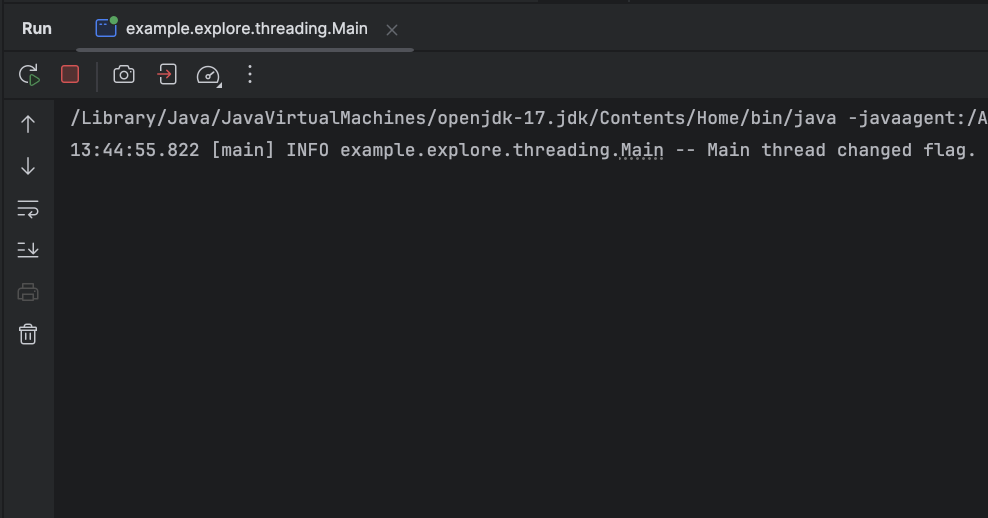
Expected problem: t may never stop, because it doesn't see running = false.
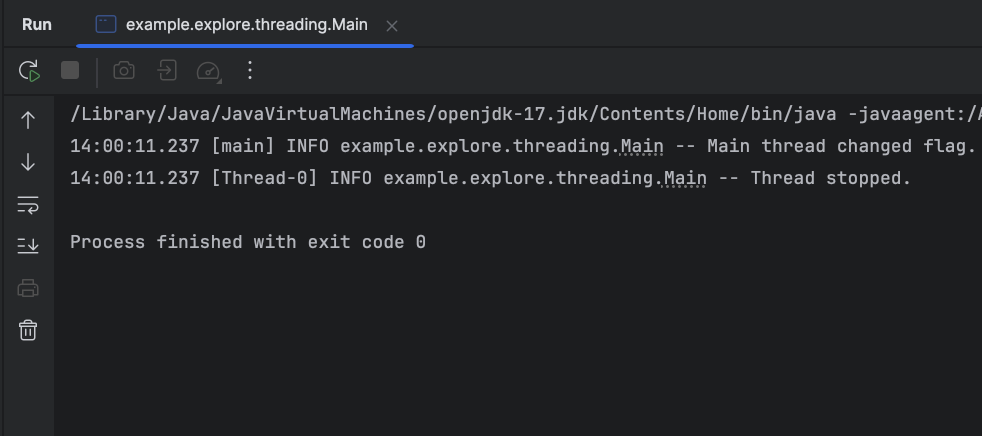
Now it stops correctly — the change to running is visible to thread t.
Related
- Atomicity Issues — visibility alone doesn't make compound operations safe.
- Ordering Issues — the other half of the Java Memory Model story.
volatileDeep Dive — visibility and atomicity side by side.