Atomicity Issues
Atomicity means a compound operation happens as one indivisible step — no other thread can
observe it half-done. count++ looks like one operation in source code, but it's really three:
read, add, write. Two threads can interleave those three steps and silently lose an update, even
if count is volatile — visibility guarantees the value is up to date at the moment of each
read, it says nothing about what happens between the read and the write.
sequenceDiagram
    participant T1 as Thread T1
    participant Mem as count (starts at 5)
    participant T2 as Thread T2

    T1->>Mem: read count → 5
    T2->>Mem: read count → 5
    Note over T1,T2: both threads now hold the same stale value
    T1->>T1: compute 5 + 1 = 6
    T2->>T2: compute 5 + 1 = 6
    T1->>Mem: write 6
    T2->>Mem: write 6
    Note over Mem: final value: 6 — one increment silently lost<br/>(should have been 7)
Neither thread did anything wrong in isolation — each one correctly read, incremented, and wrote back. The bug only exists in the interleaving, which is exactly why these bugs are non-deterministic: run it a thousand times and you'll see the right answer most of the time, then occasionally lose a handful of updates under real contention.
Why AtomicInteger fixes this without a lock
AtomicInteger.incrementAndGet() doesn't avoid the read-modify-write shape — it makes the
whole thing a single compare-and-swap (CAS) CPU instruction: "set this memory location to
expected + 1, but only if it still equals expected; tell me if it didn't." If another
thread won the race and changed the value first, the CAS fails and the JVM just retries the
whole read-compute-CAS cycle in a loop until it succeeds. No thread ever blocks waiting for a
lock — the "loop and retry" is the entire cost, which is why atomics are usually faster than
synchronized under light-to-moderate contention.
See it in code
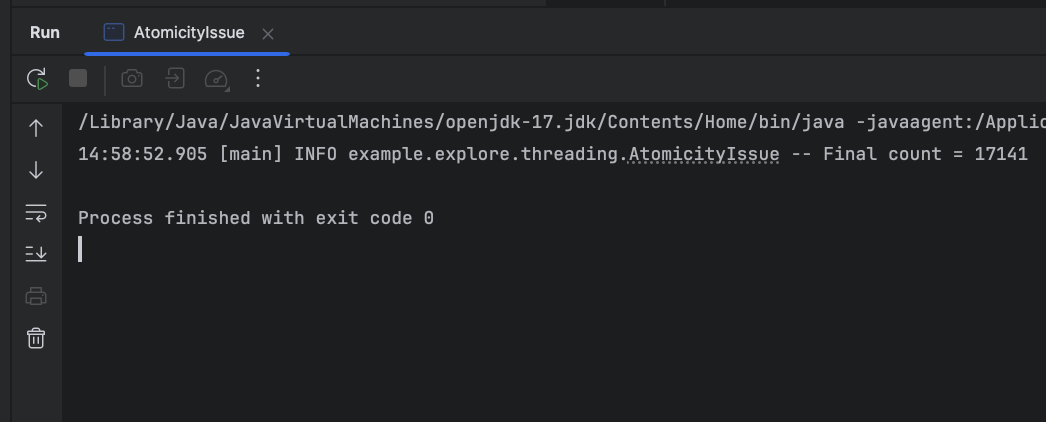
Because count++ is three operations under the hood:
- Read
count - Add 1
- Write result back
If two threads do it at the same time, they can both read the same value and overwrite each
other → lost updates. Note that count is already volatile here — visibility isn't the
problem, atomicity is.
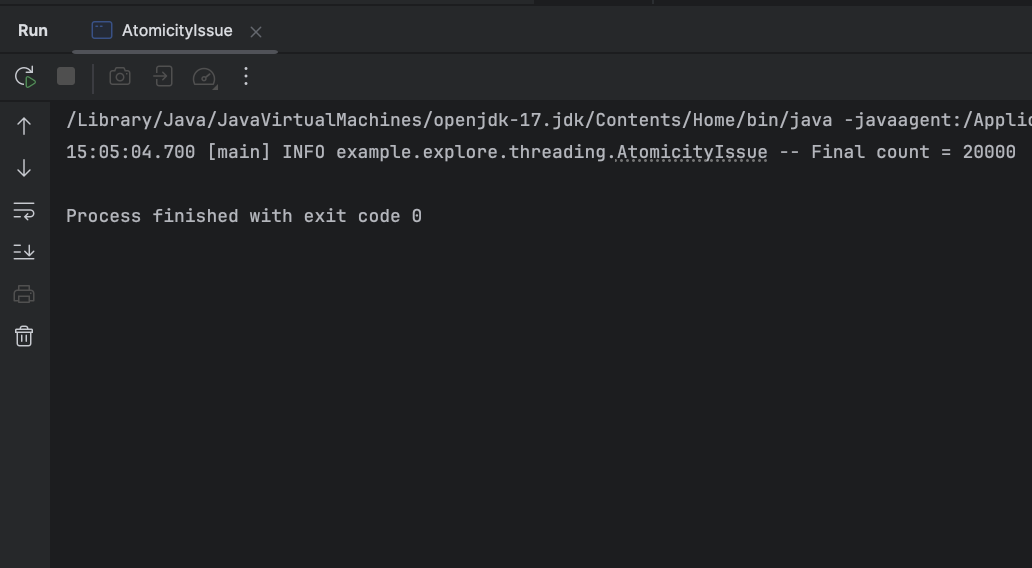
Always prints Final count = 20000 because AtomicInteger.incrementAndGet() is thread-safe.
Related
- Visibility Issues — a necessary but not sufficient condition for correctness.
- Ordering Issues — the other half of the Java Memory Model story.
volatileDeep Dive — visibility and atomicity side by side.